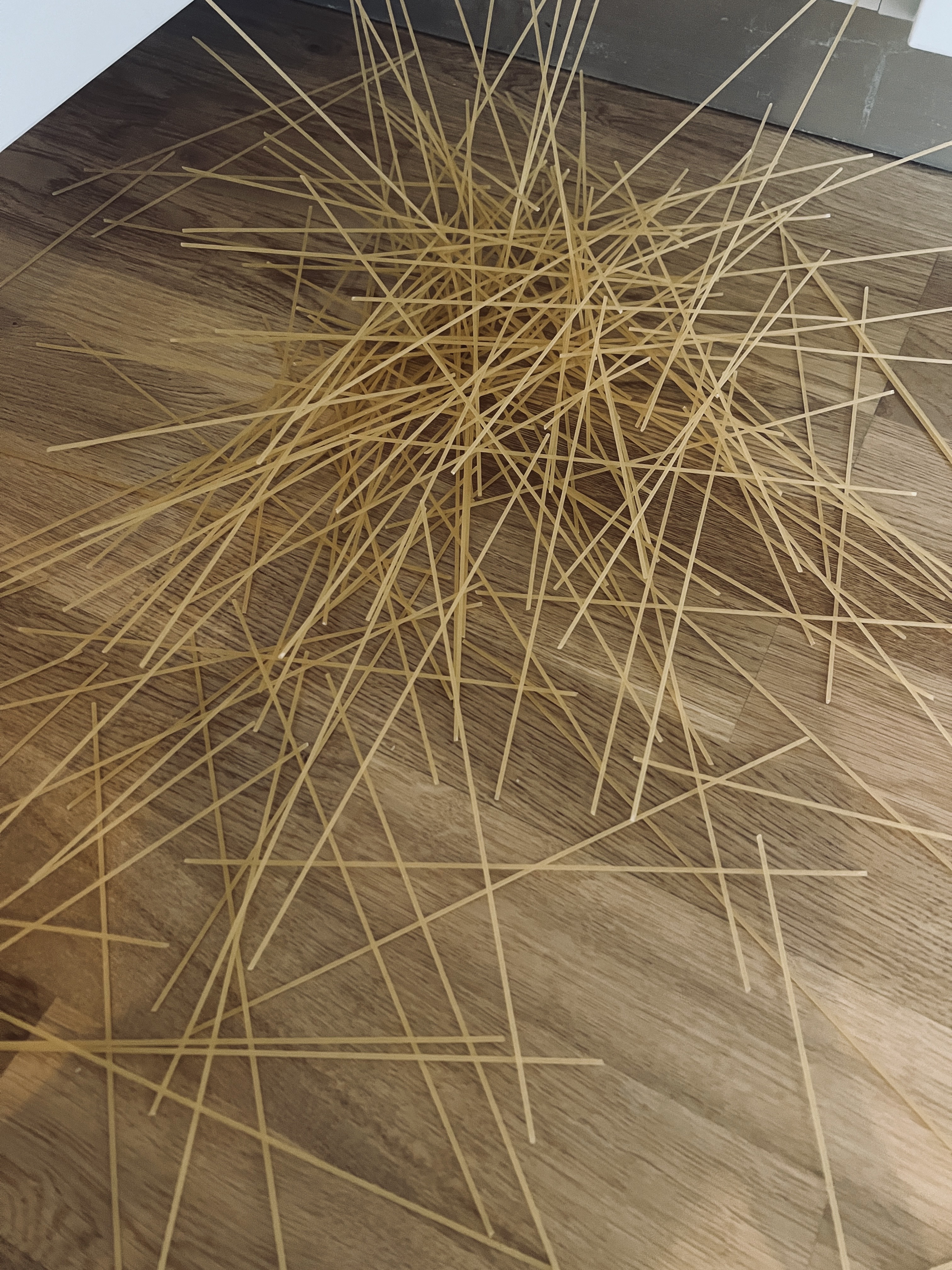
The phone doesn’t buzz and the floor stops being real.
No warning. Just suddenly the mattress has no resistance and you’re falling backward through bedframe through floorboards through the foundation of consensus reality, and you land on carpet that’s wet for no reason. The impact doesn’t hurt because pain requires a body that’s fully here, and you’re not fully here anymore.
Fluorescent panels stretch overhead, infinite. The buzz is 30 Hz exactly—you don’t know how you know this but you do, the same way you know the beige walls aren’t beige but the color of waiting, and the hallway that extends forever in both directions isn’t a hallway but a neural pathway externalized.
You check your phone. 12:27 AM. The timestamp starts dividing—12:27:00.001, 12:27:00.001.001—time fractaling into smaller increments because that’s what happens when you’re measuring the gaps between contact. Seconds become geological eras.
Behind you: movement that isn’t movement. The frequency of attention dying.
You’re in.
The first door is open before you reach it.
Inside, the geometry is simple: one chair, one clock, one window looking out at nothing. You recognize the chair immediately, green plastic, slightly too small, from the elementary school. You remember the sound you made. The classroom was full. And you were screaming.
Not screaming. Wailing. Loud, harsh, noises that filled every corner of the room, that made the walls vibrate, that drowned out the teacher’s voice. Sounds that didn’t come from your throat but from somewhere deeper—your chest tearing itself open, your lungs collapsing. You couldn’t breathe. Each inhale was a gasp, a deep-sea creature imploding from impossible pressure, and each exhale was a howl that said: I can’t be here, I can’t be here, I can’t be here.
The teacher kept teaching, her voice rising to compete with yours. The other children sat frozen, some covering their ears, their eyes sliding toward you and then away, terrified by the rawness of it. You couldn’t stop. The whole morning, hours of this relentless, primal noise. Your face was wet, your throat shredded, your body convulsing with sobs so violent they bent you double. You couldn’t tolerate the separation. The physical fact of their absence was unbearable, impossible, wrong. Your body rejected it the way it would reject death itself.
No way you could stay in this school. The noise was supposed to make them come back, to force reality to correct itself, to prove that separation this painful couldn’t be allowed to exist.
But morning ended anyway. Your voice gave out before they arrived.
The room is replicating as you watch: same chair appearing at smaller scales in the corners. Fractal architecture of a single memory: what it feels like to be abandoned.
You back out fast.
The hallway has multiplied. What was one corridor is now seven, is now forty-three, branching at angles that shouldn’t work in three dimensions. Each branch is the same hallway but constructed from different substrate—one made from the texture of read receipts, one from the specific silence after “we need to talk,” one from the molecular structure of “I’m just tired.”
Something moves between the branches. You catch it in peripheral vision: a figure that wears your shape but the proportions are wrong, limbs too long, face cycling through expressions faster than perception. When you look directly at it, it’s not there. When you don’t, it’s closer.
You run.
LEVEL -1
The stairwell appears without transition—wasn’t there, now is, the way thoughts appear without origin. Each step down takes you backward through regression layers. The walls are closer here. The lights flicker at irregular intervals that match your heartbeat exactly.
At the bottom: a room full of screens.
Not TVs. Not phones. Just rectangular light-sources showing the same scene from different angles. Someone laughing at a party you weren’t invited to. Someone posting photos with people who aren’t you. Someone online, active, just not active with you.
The screens are replicating, budding off smaller screens, each showing the same content at different temporal resolutions. The pattern is visible now: interest declining, response times lengthening, the slow withdrawal of attention that feels like dying but takes months.
The thing from the hallway is here too, standing among the screens. When you look at it through the reflections it has more coherence: your height, your build, your face but somehow conveying infinite contempt.
“Everyone gets tired,” it says, voice layered like it’s speaking from multiple time periods simultaneously. “That’s the pattern. Initial interest, comfortable period, then the slow realization that maintenance costs exceed value.”
You want to argue but the screens are showing proof: message timestamps, response-time graphs, frequency analyses. The math is clear.
LEVEL –8
The comparison chambers.
Infinite rooms, each containing two figures: you and someone else. The else-person is always better in the specific way that matters. Less anxious. More self-sufficient. Easier to love. The kind of person who doesn’t check their phone forty times an hour or need reassurance that basic affection isn’t evaporating.
The rooms branch by variable:
Room -8.1: They require less emotional labor
Room -8.1.1: They don’t catastrophize silence
Room -8.1.1.1: They believe “I’m just busy” without evidence
Each room contains smaller rooms. The fractal continues down past visibility, past meaning, into pure mathematical recursion of inadequacy.
Your phone vibrates.
The entire level freezes. Every comparison chamber pauses. The thing from upstairs stops moving.
You pull out your phone with hands shaking and the screen is blank. Phantom sensation. Your nervous system hallucinating the thing it needs most.
The chambers resume. The entity laughs—not sound, just the feeling of being laughed at, arriving directly in your brainstem.
LEVEL -∞
At the bottom of everything: a single small room.
One mirror.
You approach because there’s nowhere else to go. In the reflection: yourself at multiple ages, overlapping, translucent. Two months old turning away from the breast, mouth unable to latch, and they give you the pacifier instead. Your first lesson that when real nourishment fails, you take the empty substitute. One year old who can’t walk because the handkerchief’s other side has no hand holding it. Six years old crying in the classroom, loud harsh noises tearing through the morning, unable to tolerate the separation. Fifteen staring at a series of unresponded texts. Twenty-four sitting in a parked car after someone said they needed space. Now, holding a phone that hasn’t buzzed.
Same expression across all ages: the specific face of trying to need less, be less, take up less space in hopes of becoming acceptable.
The entity stands behind your reflection, visible only in the glass. It’s not hunting you. It is you. The part that learned early that love is provisional, that presence is earned, that the gaps between contact are gaps in your worth.
“You built this,” it says.
Not accusatory. Factual.
The Backrooms aren’t punishment. They’re architecture generated by a single recursive function:
while (self_worth == external_validation): if validation.absent(): anxiety += 1 hallway.extend() monsters.spawn() levels.descend()Every unanswered text spawns a corridor. Every hour of silence adds a level. Every “I’m just busy” that might mean “I’m losing interest” creates new entities. The structure is infinite because the loop has no exit condition.
“What if I stop running?” you ask the reflection.
“From what?”
“The fear of not being enough.”
The entity considers. “Then you’d have to sit with the possibility that it’s true. That when people leave, it’s not about their schedule or their stress. It’s about cost-benefit analysis and you cost too much.”
“Okay.”
“Okay?”
“Let it be true. I’m too much. Not enough. Requires too much maintenance. Whatever. Let it be true.”
The mirror cracks.
Not dramatically—just a hairline fracture, spreading slow. The entity looks confused, which is interesting because confusion requires expectations and you just removed the thing it was expecting: your resistance to the truth it represents.
The Backrooms begin to lose coherence.
Not disappearing. Just becoming optional. You can still see the hallways, still feel the damp carpet, still hear the entities moving through the corridors. But they’re not solid anymore. More like overlays on normal reality, visible when you’re afraid but not mandatory.
The equation is still running but you changed a variable:
while (self_worth == external_validation): // this line is the problemWhat if self-worth just… isn’t that? What if it’s a separate variable that doesn’t update based on message frequency or response time or whether someone decides you’re worth the effort?
The mirror finishes cracking. Behind it: normal space. Your bedroom. 2:00 PM. Phone showing a text from 11:22 AM: “phone died sorry”
The Backrooms fade but don’t vanish. You can still feel them there, just beneath the surface. Available. Waiting. Because anxious attachment isn’t a switch you flip. The neural pathways are carved deep, the fractal pattern is real, the entities exist as emergent properties of your own threat-detection system.
But maybe you don’t have to explore every level.
Maybe when the phone is silent you can feel the fear without falling through. Acknowledge the entities without running. See the hallways without walking them.
Or maybe you’ll fall through again tomorrow.
Probably will.
But right now, the floor is solid.
Text back: “all good”
Two words. No smiley face. No reassurance-seeking. No converting normal human behavior into evidence of abandonment.
The Backrooms hum beneath everything, infinite fractal architecture of not-enough, but you’re standing on regular floorboards in regular time.
 PSYRAW FLUX